Archive for the tag 'Hockey'

5th of April, 1920

January 30th, 2012

Frozen feet:

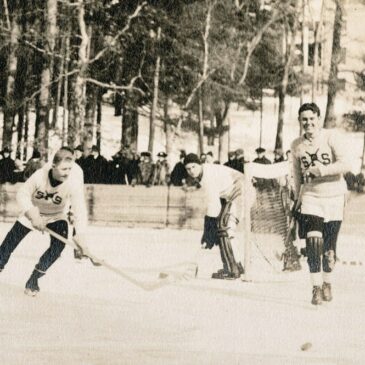
The ice in the School Pond this year has averaged about thirty-six inches thick.  Under the S. P. S. rink, which is kept clear of snow, it must have been close to the record thickness of forty-six inches.

From the Archives: Clearing the Ice

February 10th, 2011

This photo was discovered in the St. Paul’s School Archives in a box among some of  the older hockey photos.  It shows two teams of horses pulling equipment, with workers guiding the process.  Someone has penciled in “Planer” and “Scraper” under the teams, and on the back of the photo is written “L S Pond. Clearing the ice.” also in pencil.  There is no date on the photo or any identifying details to help date this image, but horses were used to clear and shave the ice at St. Paul’s in this way at least into the 1950s when the first artificial hockey rink was built.

Richard B. McAdoo, SPS Form of 1938, wrote this recollection in his Autumn 1991 Alumni Horae article:

Early on, though, we were taught that the way to cope with a New England winter is to seize hold of the sport it has to offer. Chief among these for us was hockey. Once the roads had been cleared of snow, the teams of horses were guided onto the School Pond, where the ice was two or more feet thick, to plough the drifts off the hockey rinks. A team was then hitched to the ingenious blade —it was first developed here —which shaved a thin layer off the ice and left it smooth as glass for the afternoon’s games. Learning to skate was taken as much for granted as knowing how to multiply and divide.

With all the snow that has fallen so far this winter it is difficult to imagine having to clear all the roads around SPS and enough of Lower School Pond to hold at least six rinks using teams of horses instead of snow plows and snow blowers.  Think about those horses and the workers next time you are skimming across the ice, and all the hard work that has gone into maintaining this long-standing tradition at St. Paul’s School.

From the Archives: The Cradle of American Hockey

January 5th, 2011

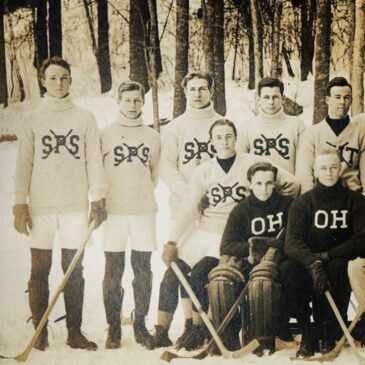
In celebration of Matthews Family Hockey Day on Saturday, January 8th, as well as the arrival of black ice and a beautiful outdoor hockey rink on Lower School Pond, Ohrstrom Library has on display in the Upper Level display cases an exhibit of historic photographs and materials from the SPS Archives entitled “St. Paul’s School : the Cradle of American Hockey.”

In St. Paul’s : the Life of a New England School, August Heckscher writes this of hockey at SPS:

At first it had been an informal scrimmage on the ice, gradually settling into a more organized contest with eleven men to a side, playing with a square piece of wood for a puck. In 1896, the Canadian version of the game, with seven players on each side, was adopted. That same year the School team played for the first time on the fabled St. Nicholas Rink in New York against a group of alumni. The alumni won 3-1. But the encounter was a spectacular event, and the School was off upon a long career of hockey playing, which was to make it known in the sports world and to fill many of the places on the top college teams with skaters trained upon the Millville ice.

You are invited to take a moment upon your next visit to Ohrstrom Library to view this exhibit created with materials from the SPS Archives, in celebration of the long and illustrious history of hockey at SPS.

New Reference Set: Statistical Encyclopedia of North American Professional Sports

April 2nd, 2009

Lura Sanborn – Reference Librarian

Statistical Encyclopedia of North American Professional Sports: All Major League Teams and Major Non-Team Events Year by Year, 1876 through 2006 2nd ed. Edited by K. Michael Gaschnitz. McFarland, 2008.

Find it in Ohrstrom at: REF 796 G21S

Use this set to locate statistics related to Major League team sports of the U.S. and Canada including: baseball, hockey, basketball, soccer and football.   Browse or search by date or team.

Use this set to determine the number of wins by the Boston Red Caps in 1876 (39); to find  that in 1959 Jean Beliveau lead the National Hockey League with 45 goals; and discover that in 1998 the Women’s National Basketball Association named Suzie McConnell Serio of the Cleveland Rockers the Newcomer of the Year.

Helpful for: Sports Fans, North American History.

Ohrstrom Library staff wishes best of luck to our spring SPS sports teams as they begin the new season: baseball, crew, lacrosse, softball, tennis and track!

Image above: Bennett, James E. Baseball Catcher. Patent 755,209. 22 Mar. 1904. United States Patent and Trademark Office. 14 Feb. 2009 <http://patft.uspto.gov/>.

The Physics of . . .

February 19th, 2009

Lisa Laughy – Archives Assistant

. . . just about everything!

A new book display in the Baker Reading Room brings together over a dozen books from the Ohrstrom Library collection that share a common thread: They all have “The Physics of” as part of their titles.  Beyond that connection it is a very diverse selection, covering topics that range from sports, music and sailing, to NASCAR, Star Trek, Superheros, and even James Bond movies.

Did you know that:

  • A baseball compresses from a round shape to an elliptical one when the bat-ball impact approaches 140 MPH?
  • When a hockey puck is tilted at a positive angle relative to the ice there is a lift force directed upward?
  • The idea behind the deflector shield on the Enterprise originated with the concept of a coherent gravitational field that creates a curvature of space?
  • Spiderman swinging on his web from building to building is a good illustration for the principle of conservation of energy?
  • Having the ideal tire slip angle on a NASCAR race car can mean the difference between spinning off the race track or speeding across the finish line?
  • The first watch camera was made in 1886, but James Bond’s ring camera worn in the film A View to a Kill is too small to actually function?

Come check out one of these interesting titles and find out some of the different ways that physics functions in your day-to-day world.

Next »